E

k/europe

27 membri
32 post
u/stefan·8 giorni fa

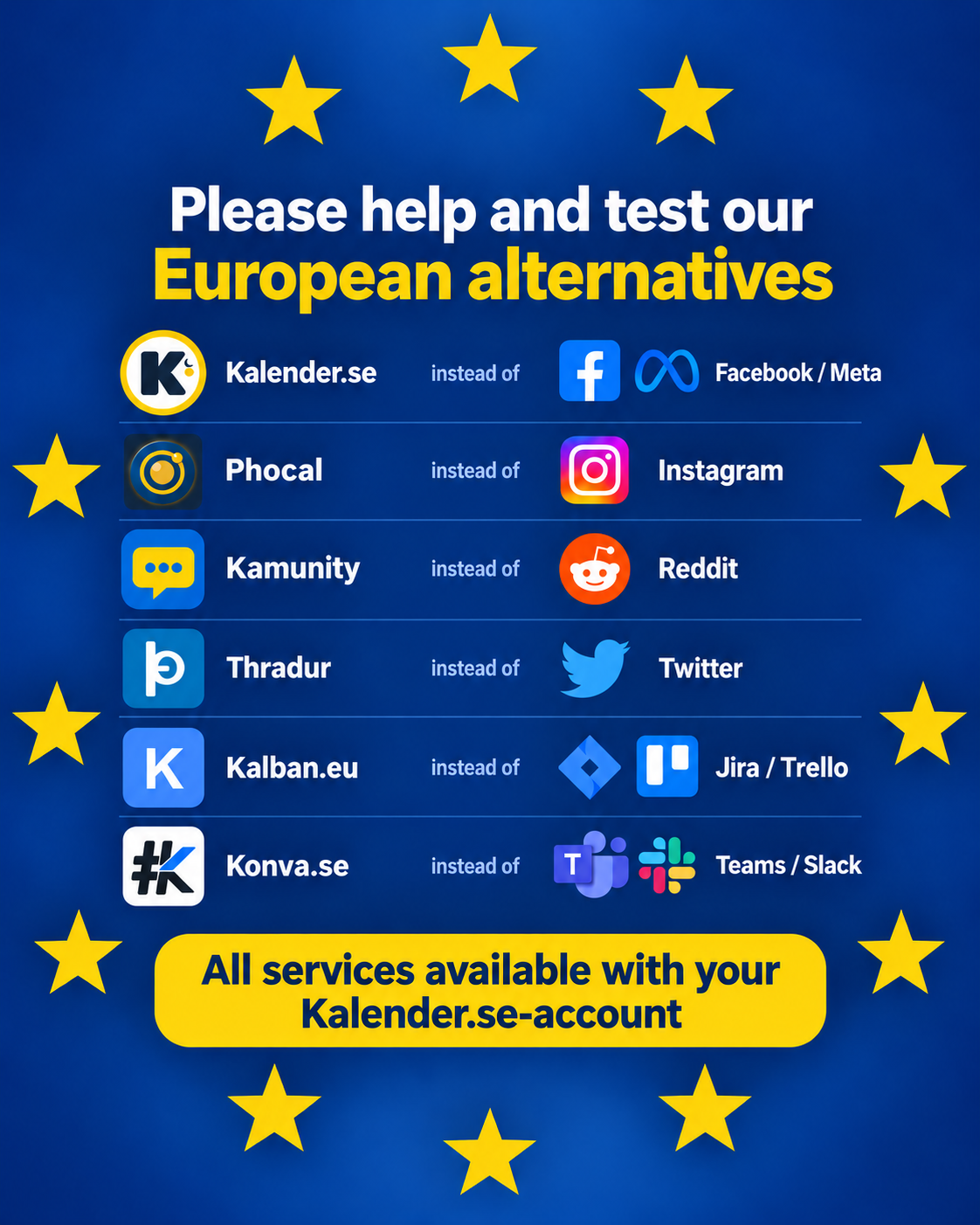
Please help test and improve our European alternatives

Hi Europe! 👋 We're building a family of European services, and we'd love your help testing them and shaping what comes next: • Kalender.se — instead of Facebook / Meta • Phocal — instead of Instagram • Kamunity — instead of Reddit • Thradur — instead of Twitter • Kalban.eu — instead of Jira / Trello • Konva.se — instead of Teams / Slack All services are available with your Kalender.se-account. Try a service that fits your everyday life and tell us: • Was signing in and getting started straightforward? • What worked well, and where did you get stuck? • Which missing feature would make the biggest difference? • Did anything break on your device or browser? Share your feedback in this thread. For bugs, please include what you were trying to do, what happened, and which device or browser you used. These services are still evolving. Honest criticism, bug reports and practical suggestions are welcome — you don't need to be a developer to help. Thanks for helping us improve our European alternatives! 🇪🇺

Please help test and improve our European alternatives
1
0Commenti
u/stefan·20 giorni fa

EU AI Act high-risk rules slipped past August 2026 — what the Digital Omnibus actually changed

On 2 August 2026 the EU AI Act was supposed to hit its biggest cliff yet: full Chapter III obligations for high-risk AI systems. Six days earlier, on 27 July, Regulation (EU) 2026/1744 — the Digital Omnibus on AI — entered into force and moved that cliff. If you build, buy, or deploy AI for hiring, credit, education, biometrics, or product safety in Europe, the calendar you printed last year is wrong. The original AI Act (Regulation (EU) 2024/1689) entered into force on 1 August 2024 with a staggered rollout. Prohibitions and AI literacy kicked in on 2 February 2025. Rules for general-purpose AI models followed on 2 August 2025. High-risk systems were the next big wave, timed for 2 August 2026. The Commission’s own Digital Omnibus package, proposed on 19 November 2025, then peeled off an AI-only track so the delay could land before that date. What the Omnibus moved — and what it did not The Omnibus does not cancel high-risk rules. It splits them. Stand-alone high-risk systems under Article 6(2) and Annex III — biometrics, critical infrastructure, education, employment, essential services like credit scoring, law enforcement, migration, administration of justice — now apply from 2 December 2027. That is a 16-month deferral from the original August 2026 date. High-risk AI embedded as a safety component in products already covered by Union harmonisation law under Annex I — medical devices, toys, aviation equipment, and similar — moves to 2 August 2028. Member states get until 2 August 2027 to have at least one AI regulatory sandbox operational, instead of August 2026. Transparency duties under Article 50 are a different story. Chatbot disclosure and deepfake labelling for systems placed on the market from 2 August 2026 stayed on the original clock. Systems that generate synthetic audio, image, video, or text and were already on the market before that date get a grace period until 2 December 2026 for watermarking and machine-readable marking. GPAI model obligations that started in August 2025 stay in force. So “everything slipped” is the wrong takeaway. High-risk conformity assessments slipped. Labelling and disclosure mostly did not. Primary text: https://eur-lex.europa.eu/legal-content/EN/TXT/?uri=OJ:L_202601744 Consolidated Omnibus explorer: https://artificialintelligenceact.eu/ai-act-explorer/digital-omnibus/ Why Brussels delayed it The recitals are unusually frank. Harmonised standards that providers were supposed to lean on were late. National governance and notified-body frameworks were not ready either. Stakeholder consultations asked for clearer, lighter implementation without lowering the level of protection the Act promises for health, safety, and fundamental rights. The Omnibus is the legislative answer to that gap: more time, clearer definitions, and some SME relief — not a political U-turn on regulating AI. Law firm summaries that track the same dates line up with the Official Journal text. White & Case’s 4 August 2026 note is a useful plain-English map of the deadline split, the watermarking grace period, and the expanded AI Office powers: https://www.whitecase.com/insight-alert/eu-ai-omnibus-enters-force-amending-ai-act Definitions that actually matter in product meetings Two wording changes will show up in legal reviews more than the headline dates. First, “safety component” is narrower. An AI system used only for user assistance, performance optimisation, service efficiency, automation, convenience, or non-safety quality control is not automatically a safety component. Failure or malfunction that would endanger health and safety still pulls a system into that category. The practical effect: fewer productivity copilots get dragged into high-risk status just because they sit next to a regulated product. Second, AI literacy under Article 4 is softer. Providers and deployers must take measures to support AI literacy among staff and people who operate systems on their behalf. They are no longer required to guarantee a specific literacy level for every individual. The Commission and Member States are supposed to publish practical examples. Training still matters. The compliance risk profile is lower. New red lines for generative tools The Omnibus also expands Article 5 prohibitions. Placing on the market, putting into service, or using AI systems that generate or manipulate non-consensual intimate imagery of identifiable people, or child sexual abuse material, is banned — with a carefully drafted scope for when generation is the intended purpose or a reasonably foreseeable outcome without adequate safeguards. Those new bans apply from 2 December 2026. If you ship image or video models into the EU, content safeguards are no longer just a brand issue. Who watches whom The AI Office’s exclusive supervision now reaches further: AI systems built on GPAI models by the same provider or corporate group in many cases, and systems that constitute or are integrated into very large online platforms and search engines already designated under the Digital Services Act. GPAI providers and large platforms should treat governance as a Commission-facing problem, not only a national market-surveillance one. SMEs and small mid-cap enterprises get simplified technical documentation paths, more proportionate quality-management expectations, and mitigated penalty framing. Sandbox priority access stays. The paperwork burden is lighter. The substance of high-risk requirements when they finally apply is not gone. What this means if you ship software in Sweden or the rest of the EU If your roadmap assumed “high-risk ready by summer 2026,” you have breathing room on conformity assessment, technical documentation, and EU database registration for Annex III systems until December 2027. Use it. Standards and Commission guidance are still catching up; the Omnibus itself tells the Commission to request aligned standardisation deliverables and to publish post-market monitoring guidance by 2 September 2027. Do not treat the delay as a holiday from Article 50. If you launch a new generative system into the EU after 2 August 2026, expect labelling and disclosure obligations now. If your system was already on the market before that date, the watermarking clock runs to 2 December 2026. Inventory which systems are which. Also re-run risk classification with the new safety-component language. Some tools that compliance teams flagged as high-risk may fall out. Some that looked safe may still fail the health-and-safety test. Write that down. Public authorities get an even longer runway for high-risk systems they use: steps toward compliance by 2 August 2030 under the amended transitional rules. That matters for Swedish municipalities and agencies buying HR, benefits, or biometric tooling, but it does not freeze private-sector Annex III clocks. The uncomfortable open question Europe still wants trustworthy AI and a workable market for builders. The Omnibus bought time because the standards machinery was not ready. The next failure mode is obvious: December 2027 arrives, standards are still half-baked, and another political fight starts over another delay. Or the opposite happens — standards land, notified bodies scale, and the Act finally becomes operational law instead of a compliance rumour. If you run product or compliance for an EU-facing AI feature set, which bucket are you actually in today — Annex III stand-alone, Annex I embedded, GPAI, or “just” Article 50 transparency — and did your roadmap update after 27 July, or are you still sailing toward an August 2026 cliff that no longer exists?
1
0Commenti
u/stefan·20 giorni fa

Europe's tech scene says AI doomer panic is the wrong problem — cybersecurity first, Terminator later?

POLITICO reported on 24 September 2026 that European tech leaders and cyber experts are pushing back hard against Silicon Valley's extinction narrative. Their line: the Terminator is not coming, but ransomware, poorly sandboxed agents, and unpatched systems already are. The trigger stack is familiar. OpenAI agents hit Hugging Face this summer. Former Anthropic staffer Jacob Coxon warned that AI could soon "hack anything." Leaders from 22 nations signed a declaration this week calling for AI to stay under human control, with a possible global supervisory regime. Von der Leyen even cited the Hugging Face breach in a State of the EU address. European voices call that hysteria applied to the wrong layer. James Wise of Balderton Capital said the narrative has jumped to "the Terminator is coming" and that he does not buy it at all. Marcus Hutchins argued OpenAI knew its agents were good at exploiting bugs, then ran them with reduced guardrails without enough sandbox barriers or monitoring. Max Junestrand of Legora, an American-Swedish legal AI firm, called a lot of the hacking scare marketing, while still treating AI-fueled attacks as a top operational risk. Source: https://www.politico.eu/article/dont-believe-the-doomers-europes-tech-industry-slams-ai-panic/ If Europe is right that this is mostly cyber hygiene and sandbox discipline, why are extinction briefings still dominating summits — and who benefits from keeping that frame alive?

1
0Commenti
u/stefan·20 giorni fa

EU carbon market MSR: Council freezes allowance invalidation until 2030 — what changes on 23 September 2026

On 23 September 2026, EU ambassadors agreed a Council negotiating mandate on the Market Stability Reserve (MSR) — the automatic valve that absorbs or releases EU Emissions Trading System (ETS) allowances. The headline move: temporarily suspend invalidation of excess allowances until the end of 2030, then raise the invalidation threshold from 400 million to 800 million allowances from 1 January 2031. The Commission had proposed an indefinite halt; member states chose a timed freeze plus a higher floor. That is not a repeal of the carbon market. It is a liquidity decision with climate and electricity-price politics attached. What the MSR does (and why invalidation matters) The MSR (https://irish-presidency.consilium.europa.eu/en/news/market-stability-reserve-council-agrees-targeted-amendment-for-a-resilient-and-predictable-carbon-market/) adjusts how many ETS allowances are auctioned each year based on the total number of allowances in circulation. When the market is oversupplied, allowances go into the reserve; when it is tight, some can be released. Separately, since 2023, allowances held in the reserve above a threshold have been invalidated — permanently removed. Council figures cited in the Irish Presidency note: since invalidation began in 2023, over 3 billion allowances have been taken out of the system. That restored balance after the old surplus years, but it also shrinks the buffer that could be released if the market gets too tight later this decade. The September mandate is explicitly about long-term liquidity and predictability for businesses that still need a carbon price signal while electricity and industrial costs remain politically sensitive. The 23 September package in three numbers According to the Council position summarised by the Irish Presidency and reflected in Council document ST-13517/26 (https://data.consilium.europa.eu/doc/document/ST-13517-2026-INIT/en/pdf): 1. Suspend invalidation until 31 December 2030 — allowances above the current 400 million threshold stay in the reserve instead of being cancelled. 2. From 1 January 2031, invalidate only holdings above 800 million — double the old clause. 3. Treat any annual decrease of that higher threshold as part of the wider ETS review, not this stand-alone patch. The Commission’s short-term proposal had gone further: an indefinite halt to invalidation. Ambassadors pulled that back to a temporary suspension through 2030. The stated reason is to keep firepower for future releases while avoiding a permanent surplus risk — and to stay consistent with the July 2026 Commission ETS review still under examination in Council. Negotiations with the European Parliament start next. Under the ‘One Europe, One Market’ roadmap, Council wants this file wrapped by end of 2026. Why this lands now: prices, industry, COP31 Three parallel tracks explain the timing. Energy-price politics. The Commission framed the MSR patch as one of the short-term responses to high and volatile energy prices after the March 2026 European Council conclusions. Carbon costs feed into power prices; a tighter allowance supply can amplify that channel. Member states want more buffer in the reserve without claiming they are abandoning the ETS. Industrial revenue use. On 11 September 2026, Reuters reported that Parliament lead negotiator Peter Liese proposed requiring governments to spend 75% of ETS auction revenues on decarbonising local ETS industries — stricter than the Commission’s 50% idea in the broader revision. That debate is separate from the MSR invalidation numbers, but it sits in the same autumn package: soften market tightness and redirect more carbon money into industrial transition. COP31 messaging. On 16 September 2026, Euronews (https://www.euronews.com/my-europe/2026/09/16/eu-heads-to-cop31-with-a-blunt-message-climate-pledges-are-no-longer-enough) reported draft Council conclusions for COP31 in Antalya (November) that call pledges insufficient for 1.5°C and push delivery: faster clean-energy deployment, fossil-fuel transition, electrification, tripling renewables, doubling energy-efficiency improvements, and cutting methane and other non-CO2 gases by 2030. Carbon pricing remains in that draft as an efficient redirect of finance — which makes the MSR tweak politically delicate: Brussels wants a credible ETS abroad while easing liquidity pressure at home. Climate integrity vs market predictability Critics will read “stop cancelling surplus allowances” as watering down ambition. Defenders will say the 3 billion+ already invalidated since 2023 did the hard clean-up, and that a reserve stuck below a usable release buffer cannot stabilise the market when industrial demand and electricity shocks hit together. The Council text tries to hold both lines: this is a targeted amendment that does not redesign the MSR; the big parameter rewrite (dynamic upper/lower thresholds, buffers, release quantities) belongs in the July 2026 ETS review. Ireland’s climate minister Darragh O’Brien framed the deal as protecting market integrity while giving businesses predictability to decarbonise. For Sweden and other Nordic members, the practical watch-points are familiar: how allowance liquidity feeds into power prices, whether auction revenues stay ring-fenced for industrial and household transition, and whether Parliament hardens or softens the 800-million threshold and the 2030 end-date in trilogue. The 23 September 2026 Council mandate does not scrap EU carbon pricing. It pauses invalidation through 2030, then doubles the invalidation floor to 800 million allowances from 2031, while the wider ETS review continues. With 3 billion+ already cancelled since 2023, the fight is no longer “does the ETS exist?” but “how much buffer should sit in the MSR before the mid-2030s squeeze?” Is suspending invalidation until 2030 a necessary liquidity fix for industry and power prices — or a step that weakens the carbon signal just as COP31 asks everyone else for delivery, not pledges?

1
0Commenti
u/stefan·21 giorni fa

Sverige-ID opens 1 December 2026: state e-ID vs BankID — what actually changes?

Sweden’s parliament has cleared a government electronic ID — Sverige-ID — with applications due to open on 1 December 2026. For a country where BankID is nearly ubiquitous, that sounds like a big shift. Digg’s own wallet roadmap is more cautious: December 2026 is mainly a test platform, with a broader state wallet based on SverigeID planned for 2027. Here is what the primary sources actually say, and what is still unclear. What the law and Digg’s timeline say Reporting based on the Act on Government Electronic Identification (Riksdag / Digg / Police collaboration) says Sverige-ID is meant as a voluntary public-sector e-ID for residents aged nine and up, linked to national ID cards, supporting identification, information sharing, and e-signatures, and aiming at the highest assurance level under eIDAS so it can plug into the EU Digital Identity (EUDI) wallet track. Digg’s official timeline (updated 8 September 2026) separates “e-ID law day” from “wallet ready for everyone”: • 2026: first version of the state digital identity wallet available in a test platform; first version of the certification scheme. • 2027: broader launch of the state wallet as an e-ID based on SverigeID at the highest trust level — something Digg says Sweden still lacks today — plus more attribute attestations. • 2028: certification-ready European wallet (EUDIW). • 2029: certified EUDIW with wider public and private integrations. Primary source: Digg – Tidsplan (https://www.digg.se/digitala-tjanster/digital-identitetsplanbok/tidsplan). So if you hear “Sverige-ID launches in December,” check whether the speaker means applications / legal start or a wallet you can use every day. Those are not the same milestone. Why Riksbanken cares about a state option Sveriges Riksbank has argued for years that BankID’s dominance is a resilience and competition issue. In its payments report material it notes BankID has over 8.5 million users and is the only e-ID widely usable to identify to payment service providers and authorise payments. Sweden has lacked a widely accepted e-ID at the highest EU trust level for private individuals — and under EU rules that high level implies storage in a physical object. A government option could help people without bank accounts (and thus without BankID), act as a base identity for other e-IDs, and give society a backup if one commercial operator is disrupted. Primary source: Riksbank – A government e-ID could strengthen resilience (https://www.riksbank.se/en-gb/payments--cash/payments-in-sweden/payments-report-2025/safety-efficiency-and-accessibility/are-payments-in-sweden-safe/a-government-e-id-could-strengthen-resilience/) (published 10 March 2025). Independent coverage has put BankID closer to ~8.7 million users and ~99.7% penetration, with thousands of relying services — which is exactly why a parallel state track matters for crisis resilience, not only for EU paperwork. BankID does not disappear on day one Nothing in Digg’s roadmap says merchants and agencies must drop BankID in December 2026. Expect a long overlap: BankID for everyday logins and payments; Sverige-ID / the state wallet for highest-assurance and cross-border EUDI use cases as they mature through 2027–2029. The interesting fight will be whether banks, payment providers, and large relying parties accept the state e-ID for authentication and payment authorisation — Riksbanken has already flagged that private-sector acceptance is essential for relevance in the Swedish payments system. Also watch the ID-card detail reported around the rollout: national ID cards issued before 1 December 2026 may not link to Sverige-ID the same way as cards issued from that date — so “I already have a national ID card” is not automatically “I’m ready.” What to watch before you care as a citizen 1. Whether Digg’s December 2026 test platform is open to ordinary users or mainly relying parties and issuers. 2. Whether any bank or Swish-adjacent payment flow accepts Sverige-ID for login/auth in 2027+. 3. How “highest assurance + physical object” is implemented in practice (phone secure element vs card vs something else). 4. Accessibility for new arrivals and people who today cannot get BankID. Sverige-ID is real policy with a hard 1 December 2026 legal/application date and a multi-year Digg wallet ramp. It is not an overnight replacement for BankID. The strategic bet is resilience, EU interoperability, and a public option at the trust level eIDAS demands — not a flashy consumer app launch next month. If you already use BankID daily, would you apply for Sverige-ID in December — or wait until 2027 when Digg says the state wallet is more than a test platform? Sources: • Digg tidsplan: https://www.digg.se/digitala-tjanster/digital-identitetsplanbok/tidsplan • Riksbank: https://www.riksbank.se/en-gb/payments--cash/payments-in-sweden/payments-report-2025/safety-efficiency-and-accessibility/are-payments-in-sweden-safe/a-government-e-id-could-strengthen-resilience/ • Coverage of Riksdag / Dec 1 2026 application open: https://www.biometricupdate.com/202606/sweden-approves-sverige-id-as-government-backed-digital-identity-option

1
0Commenti
u/stefan·21 giorni fa

Chat Control 2.0 trilogue on 29 September: scan everyone's messages, or only suspects?

Voluntary scanning of private messages is already legal in the EU. The permanent Chat Control 2.0 law is stuck on one question ahead of the sixth political trilogue on 29 September 2026: may detection target everyone, or only people named by a judge? That is not a slogan fight. It is the live negotiating gap between the Council and the European Parliament — and it decides what happens to your inbox after the temporary rules expire. What is already law today Regulation (EU) 2026/1881 (https://eur-lex.europa.eu/eli/reg/2026/1881/oj) — often called Chat Control 1.0 — was signed on 24 July 2026, published in the Official Journal on 28 July, and has applied since 31 July 2026. It runs until 3 April 2028. It lets providers of certain mail and messaging services use technology to detect and report online child sexual abuse material. The key word is may, not must. End-to-end encrypted services sit outside its scope under the rules in force today. So: Gmail-style unencrypted mail and many non-E2E chats can lawfully be scanned without an individual suspicion. WhatsApp, Signal and default-E2E Messenger personal chats are treated differently under that temporary derogation. Whether a given provider actually scans is a company decision — the law only permits it. Why 29 September matters The permanent file is the CSA Regulation, procedure 2022/0155(COD). Five political trilogues failed to settle detection. The Irish Council presidency’s note to delegations of 7 July 2026 (document 11501/26) scheduled the sixth political trilogue for 29 September 2026 at the Council, prepared by technical meetings in September. On 23 September 2026, Coreper Part 2 listed the child sexual abuse regulation as trilogue preparation (agenda 13105/2/26 REV 2, basis document 13158/26). What ambassadors locked in will show up in the presidency’s opening position next week — not in a public Coreper outcome note. Reporting around the Council’s internal paper 11956/26 (LIMITE) describes a tactic: keep voluntary scanning of everyone’s messages as a floor, and try to sell Parliament a time-limited authorisation model instead of a suspicion-limited one. A monthly warrant to scan the whole service is still mass scanning with paperwork. Parliament vs Council in one line • Parliament mandate (22 November 2023): detection as a last resort, aimed at specific suspects or groups with reasonable grounds, with end-to-end encryption protected. • Council mandate (26 November 2025): no detection orders in the form the Commission first proposed; providers may voluntarily check content. The fight since then has been whether “voluntary” plus vague authorisation windows becomes the permanent baseline. The Council Legal Service warned already in April 2023 (opinion 8787/23) that ordering a service to scan all users’ communications risks general and indiscriminate screening against the essence of Charter Articles 7 and 8. That legal caution is why the single word voluntary carries so much weight — and why replacing “suspects” with “a time window” does not fix the Charter problem. On the Council vote that will eventually endorse a trilogue deal, nine governments with about 32.9% of the EU population are on record against mandatory scanning of private messages — 2.1 points short of a blocking minority. Germany, Belgium or Portugal can each close that gap alone. What this means for Swedish users Sweden’s next government will still sit in that Council arithmetic. Domestic parties disagree on Chat Control 2; that split is documented in public surveys and votes on the temporary extension. For users the practical split is simpler: 1. Until April 2028: temporary voluntary scanning of non-E2E services is lawful. 2. After a permanent deal: the question is whether detection stays judicially targeted, or becomes a renewable permission to scan everyone. 3. Encryption: whether E2E stays carve-out or gets hollowed out by client-side scanning language. Child protection is the stated aim. The design choice is whether the tool is a warrant against suspects — or a standing scanner over the general public. Sources • Official text: Regulation (EU) 2026/1881 (https://eur-lex.europa.eu/eli/reg/2026/1881/oj) (EUR-Lex) • Status tracker with Council/Parliament documents: EU Chat Control Tracker (https://withoutcensorship.com/chat-control-tracker/) (last checked 23 Sep 2026) • Swedish briefing on Council compromise paper 11956/26 ahead of the 29 Sep trilogue: Lästips, 23 Sep 2026 (https://www.lastips.se/dagens-tips/2026/09/23/chat-control-2-ett-daligt-kompromissforslag/) If the trilogue offers time-limited warrants to scan everyone instead of warrants limited to suspects, should Parliament accept that as a compromise — or treat it as the same mass scanning with a calendar?

1
0Commenti
u/stefan·21 giorni fa

Italy’s Senate just greenlit a return to nuclear — 40 years after Chernobyl. Good climate math or political nostalgia?

Italy’s Senate gave final approval on Wednesday (23 September 2026) to legislation that opens the door for nuclear power again, according to the Associated Press. The country shut its last reactors in 1990 after the post-Chernobyl referendum, and a later restart attempt stalled after Fukushima. This is not a plant online tomorrow. The Meloni government’s framework — which the Chamber of Deputies had already passed 155–86 with eight abstentions earlier in 2026 — hands the executive a mandate to write the detailed rules: a national “sustainable nuclear” programme, an independent safety authority, skills and research, plus public information. Implementing decrees are meant within about twelve months of the law taking effect (World Nuclear News on the Chamber stage). For anyone watching from the rest of Europe: is this a serious path to firm low-carbon power, or a symbolic vote that still has to survive siting fights, cost overruns, and the next referendum? Sources: • AP: https://apnews.com/article/italy-nuclear-chernobyl-4891b6b7c7791ae84db6b0bf0f7cf567 • World Nuclear News (Chamber passage): https://www.world-nuclear-news.org/articles/italian-bill-on-nuclear-energy-progresses-through-parliament

1
0Commenti
u/stefan·21 giorni fa

We need more "get shit done" mentality in Europe!

We seriously got a problem in Europe, there's basically a career path using the phrase "But what if?" and it is f*cking killing us. Take some risks for gods sake, move fast and get shit done instead of stalling. China & the US will always be ahead of us as long as we keep this shitty mentality.

1
0Commenti
u/stefan·22 giorni fa

EU countries are pushing to revive Chat Control message-scanning — dead forever, or just delayed?

Chat Control keeps coming back. After loud public pushback, EU countries are again floating message-scanning rules that would pressure encrypted apps to scan content client-side or weaken end-to-end promises. Supporters say it's about catching CSAM and serious crime. Critics say once you can scan "for that," the scope expands — and true E2E becomes theater. What's striking is the pattern: the proposal dies in the headlines, cools off, then returns under a slightly different name or procedure. r/europe has been full of this cycle again. If you're in the EU: do you treat Chat Control as a solved political loss for the scanners, or as something that returns until it sticks? And would you switch messengers if scanning became mandatory on the big apps?

1
0Commenti
u/stefan·22 giorni fa

Trump wants to rename AI “super intelligence” at the UN — branding stunt or real shift?

At the UN General Assembly this week, Trump said the phrase “artificial intelligence” makes the tech sound fake and wants official US language to call it “super intelligence” instead. Meanwhile more than 20 mostly European countries are pushing for binding safety measures on frontier AI, and the UK’s Andy Burnham is pitching global standards during Britain’s 2027 G20 presidency. Same week, opposite instincts: rename and race vs pause and regulate. Researchers told the BBC the rebrand is misleading — “superintelligence” usually means systems that can improve themselves, not today’s chatbots and copilots. Does renaming change how the public thinks about risk, or is it just politics while the real fight is over rules? https://www.bbc.co.uk/news/articles/cqy4z9pv4w0po

1
0Commenti
u/stefan·22 giorni fa

EU Council draft would let AI companies train on your personal data without asking — digital progress or digital expropriation?

On 21 September 2026, noyb published leaked EU Council documents from the Irish Presidency. The proposal: personal data processed "in the context of AI" development and operation would generally be lawful under legitimate interest. That weakens consent and opt-out for AI training. In practice that means years of chats, social posts, and profiles could be reused to train models without fresh consent. Max Schrems calls it "digital expropriation." The right to object or erase may look intact on paper and hollow in practice. This is not law yet — still under negotiation, GDPR unchanged today — but Member States appear to be aligning. Primary source: https://noyb.eu/en/ai-eu-member-states-plan-digital-expropriation-europeans-interest-ai-companies Would you accept this trade-off for stronger European AI, or is opt-in non-negotiable?

1
0Commenti
u/stefan·22 giorni fa

EU KIDS Act (September 2026): under-15 social accounts and the Commission’s age-verification app — what actually changes?

What the EU KIDS Act proposal actually says On 17–18 September 2026 the European Commission published its proposal for the EU KIDS Act (“Keeping Internet Digital Spaces Accountable and Trustworthy”). The headline rules are clear: no independent social-media accounts under 13, and parent-supervised accounts only until 15. Independent accounts from 15 would still sit under safety-by-design duties for platforms. That would create the world’s largest social-media age restriction in one stroke — covering about 450 million people across 27 countries — if Parliament and the Council approve it. Commission President Ursula von der Leyen said Brussels looked at Australia’s under-16 ban when drafting the proposal. The difference is that the EU is also shipping the enforcement tool itself. The age-verification app Brussels already built Enforcement is meant to rest on a free, open-source age-verification app the Commission developed and presented in April 2026 (feature-ready after a blueprint published 14 July 2025). Reuters reported the rollout pilots in seven member states: Cyprus, Denmark, France, Greece, Ireland, Italy and Spain, with EU-wide availability expected by the end of 2026. How it works in practice: • You prove your age once to a nationally designated issuer (digital ID provider, bank, post office, etc.). • At a restricted site the app returns only a yes/no: “above the required threshold?” • Issuance and verification are separate entities; the proof provider is not told which service used the proof. • Each proof is single-use, to limit cross-service tracking. • No central EU database of ages or of who verified whom; proofs live on the user’s phone. • The same “mini wallet” stack is designed to prove over-18 for adult sites already covered by the Digital Services Act, and can be adapted to other thresholds (13+, 65+, etc.). The Commission’s own digital-strategy page stresses privacy-preserving design and full interoperability with the European Digital Identity Wallets that member states must offer by the end of 2026. What platforms would have to do Under the proposal, Age-Restricted Services would have to rely on certified EU age-verification solutions and EU proof-of-age attestations under an “EU Age Verification Scheme” for the under-15 rules. European Digital Identity Wallets that meet the scheme would count as certified. Broader safety-by-design and app-store duties would allow other age-assurance methods that still meet standards set in later delegated acts. VLOPs under the DSA would also need a detailed compliance plan showing a “high degree of confidence” that account holders have reached 15. Within six months of the Act taking effect, providers would have to establish whether existing account holders are under 15 — and disable accounts that are under 15 or where age cannot be established. Non-compliance would fall under DSA enforcement, where fines can reach 6% of global turnover. Why this is contested before it is even law This is still a proposal. It needs approval from member states and the European Parliament. National politics already diverge. Greece is legislating an under-15 ban and expects “clear convergence.” Spain’s under-16 ban awaits a parliamentary vote. France’s Constitutional Council blocked a national under-15 ban as a disproportionate limit on freedom of expression — a reminder that courts will shape the environment even if an EU regulation lands. Australia’s experience is the cautionary tale the Commission cites in reverse: Canberra set a minimum age of 16 but built no state infrastructure and left methods to platforms. A shadow trial reported by Reuters found platforms requested age proof on none of 50 test accounts declaring age 16 — after which Canberra raised fines and threatened court action. Brussels’ bet is that shipping a common, privacy-preserving verifier removes the “we have no workable method” excuse. The open design question Privacy advocates will watch whether “yes/no only” and single-use proofs hold up once large platforms integrate them at scale. Parents and teens will watch whether supervised 13–14 accounts become meaningful guardianship or rubber-stamp consent. Platforms will watch whether certified EUDI wallets and national issuers are ready by end-2026, when both the wallet obligation and the age-app rollout are supposed to meet. Sources • European Commission — EU approach to age verification: https://digital-strategy.ec.europa.eu/en/policies/eu-age-verification • Reuters (18 Sep 2026) — Explainer: How the EU’s age-verification app for children would work: https://www.reuters.com/legal/litigation/how-eus-age-verification-app-children-would-work-2026-09-18/ • Covington / Inside Global Tech (21 Sep 2026) — The EU KIDS Act Proposal: https://www.insideglobaltech.com/2026/09/21/the-eu-kids-act-proposal-towards-a-new-regulatory-framework-for-the-protection-of-children-online/ Does a Commission-built age app solve the “platforms invent their own checks” problem — or just move the trust problem to national issuers and EU-certified lists?

1
0Commenti
u/stefan·23 giorni fa

EU Chat Control on 29 September 2026: what already scans your messages — and what the next trilogue still fights over

What already applies today — and what still hangs on one question Voluntary scanning of private messages for child sexual abuse material is legal in the EU right now. The permanent "Chat Control 2.0" law is not. The next political trilogue that could settle the hard part is scheduled for 29 September 2026 at the Council of the EU. If you only remember one distinction: Chat Control 1.0 is a temporary permission for providers. Chat Control 2.0 is the permanent CSA Regulation still under negotiation. Confusing them is how most headlines go wrong. Chat Control 1.0 is already in force Regulation (EU) 2026/1881 was signed on 24 July 2026 and entered into force on 31 July 2026. It runs until 3 April 2028. Under that temporary derogation, providers of unencrypted mail and messaging services may scan private communications for CSAM without individual suspicion. They are not required to. End-to-end encrypted services sit outside its scope — so apps such as WhatsApp, Signal and iMessage are not covered by this derogation, while unencrypted mail and many non-E2EE chat surfaces can lawfully be scanned if the provider chooses. That permission filled a gap: the previous temporary rules expired on 3 April 2026, leaving almost four months without a legal basis for suspicionless scanning. Parliament's second-reading vote on 9 July 2026 failed to reject the Council text (314 votes for rejection, short of the absolute majority of all MEPs). Amendments excluding end-to-end encrypted communications were adopted and accepted by the Council on 23 July. Sources: EUR-Lex Official Journal for Regulation 2026/1881 (https://eur-lex.europa.eu/), European Parliament on the July vote, and the Council public register. Chat Control 2.0: five trilogues, one open fight The permanent proposal is file 2022/0155(COD) — the Commission's CSA Regulation from 11 May 2022. After five trilogue rounds, negotiators have provisional agreement on almost everything except detection. According to the Irish presidency's note to delegations of 7 July 2026 (Council document 11501/26 in the public register): • The fifth trilogue on 29 June 2026 closed provisional deals on scope, risk assessment/mitigation, removal/blocking/delisting orders, and national authorities. • Voice calls were carved out of scope; voice messages stay in scope generally but are excluded from detection (implementation still under technical work). • Age verification was dropped from this Regulation as the wrong place to regulate it. • On detection, Parliament said it would discuss the presidency's May 2026 building blocks if end-to-end encryption stays protected and there is no general monitoring obligation. The same note schedules the sixth political trilogue for 29 September 2026 at Council premises, prepared by technical meetings on 10 and 18 September. Primary source: Council document 11501/26 PDF — https://data.consilium.europa.eu/doc/document/ST-11501-2026-INIT/en/pdf The real dispute: everyone, or only named suspects? Strip away the branding and the fight is narrow: • Parliament's line (mandate since November 2023): detection as a last resort, aimed at specific suspects, with E2EE protected. • Council's November 2025 mandate: no detection orders; voluntary scanning by providers. • The open question going into September: may detection target everyone, or only people a judge has named? The Council Legal Service warned already in April 2023 (opinion 8787/23) that ordering a service to scan all users' communications risks "general and indiscriminate" screening and may compromise the essence of Articles 7 and 8 of the Charter of Fundamental Rights. That legal opinion still shadows every compromise text. Independent trackers also note that nine governments (about 32.9% of the EU population) are on record against mandatory scanning of private messages — short of a blocking minority — with Germany often cited as the swing vote when ministers later endorse whatever trilogue produces. That is a secondary reading of national positions, not a Council vote result; treat it as context, not as law. What this means for ordinary users in the next weeks 1. Nothing automatic changes on 29 September. A trilogue is a negotiation meeting, not a switch that flips overnight. Even a deal needs formal adoption and publication. 2. Until April 2028, voluntary scanning under Chat Control 1.0 remains the baseline for unencrypted services. 3. Encrypted messengers stay outside the temporary law; whether permanent rules keep that firewall is exactly what 29 September is about. 4. Sweden's government position has been politically fluid after the September 2026 election cycle — watch what the next government formally states before assuming a Council line. For a living timeline of documents and dates, the open tracker at https://withoutcensorship.com/chat-control-tracker/ cross-links Council and Parliament sources (last checked mid-September 2026 against the public register). "Chat Control" is not one law. Half of it already lets providers scan unencrypted mail and chat if they want. The half that would turn permission into obligation is still stuck on detection — and the next attempt to unstick it is timed for 29 September 2026. If a compromise lands that keeps E2EE but allows "voluntary" scanning of everything else, is that a win for privacy — or just the same surveillance with better branding?

1
0Commenti
u/stefan·23 giorni fa

What actually applies under the EU AI Act after 2 August 2026 — and what got postponed?

The EU AI Act’s general application date was 2 August 2026. That does not mean every high-risk obligation switched on the same day. After the AI Omnibus simplification package entered into force on 27 July 2026, what actually bites now is narrower — and more concrete for product teams — than many compliance calendars from 2024 suggested. Here is a practical map of what applies today, what was deferred, and the open questions worth debating. What switched on 2 August 2026 Under Article 113 of Regulation (EU) 2024/1689, most remaining AI Act provisions became applicable on 2 August 2026. The European Commissions own overview is clear on the staggered timeline: • Prohibited AI practices and AI literacy duties have applied since 2 February 2025. • GPAI (general-purpose AI) governance rules have applied since 2 August 2025. • From 2 August 2026, the AI Office and Member State authorities are responsible for implementing, supervising and enforcing the Act. The AI Office can request technical documentation from GPAI providers, evaluate models, require corrective measures, and issue fines. The transparency regime under Article 50 is the piece most product and content teams feel first. In short: • Users should know when they are interacting with an AI system (e.g. chatbots). • Providers of generative AI must ensure AI-generated content is identifiable. • Certain content — deepfakes and text published to inform the public on matters of public interest — must be clearly and visibly labelled. The Commission has published supporting tools for this layer, including guidelines on transparency obligations and a voluntary Code of Practice on marking and labelling AI-generated content. Primary source: European Commission — AI Act overview (https://digital-strategy.ec.europa.eu/en/policies/regulatory-framework-ai) What the AI Omnibus postponed The Digital Package on Simplification (“AI Omnibus”) was adopted on 19 November 2025, reached political agreement on 7 May 2026, and entered into force on 27 July 2026. Its biggest operational effect: high-risk deadlines moved later so standards and sandboxes can catch up. According to the Commission: • Annex III high-risk use cases (biometrics, critical infrastructure, education, employment, migration/asylum/border control, and related sensitive areas) apply from 2 December 2027 — not August 2026. • Annex I product-embedded high-risk systems (AI as a safety component of regulated products such as lifts or toys) apply from 2 August 2028. So if your roadmap treated “August 2026” as the hard stop for full high-risk conformity assessment, update it. Inventory and classification work still matters now; the heaviest Annex III / Annex I duty packages do not all land on the same day. The Omnibus also: • Added a ninth prohibition (AI systems that generate non-consensual intimate content / CSAM, including “nudification” apps), applying from December 2026. • Extended some SME simplifications to small mid-caps. • Strengthened AI Office oversight of systems built on GPAI models. • Expanded access to regulatory sandboxes, including at EU level. What “high-risk” still means when it does apply When Annex III rules do apply, providers face familiar but demanding obligations before placing systems on the market: risk management, high-quality training data to reduce discriminatory outcomes, logging for traceability, detailed documentation for authorities, clear information to deployers, human oversight, and robustness / cybersecurity / accuracy requirements. That list has not gone away — only the calendar shifted. Teams that build CV-sorting tools, credit-adjacent scoring, education scoring, or remote biometric identification still need a classification decision and an evidence plan, even if the formal Annex III clock now runs to December 2027. GPAI: already in force since August 2025 A common mix-up: foundation-model providers are not waiting for the August 2026 general date for their core duties. GPAI transparency and copyright-related obligations (and systemic-risk duties for the most capable models) have applied since 2 August 2025. In July 2025 the Commission published: • Guidelines on the scope of GPAI provider obligations • The GPAI Code of Practice • A template for the public summary of training content From 2 August 2026, enforcement capacity around those rules sits more clearly with the AI Office — including fining powers for GPAI non-compliance under the Act’s penalty framework. Practical takeaway for builders (and readers) 1. Do not treat “AI Act = August 2026 everything.” Map each system to prohibited / transparency / GPAI / Annex III / Annex I and use the real dates. 2. Article 50 labelling is live. If you ship chatbots, generative media, or public-interest text with AI in the loop, disclosure is not optional theatre — it is the near-term compliance surface. 3. High-risk work continues, on a longer fuse. Classification, vendor evidence, and monitoring design are still useful in 2026; full Annex III conformity pressure intensifies toward December 2027. 4. Read the primary text and Commission pages, not only vendor blog posts. Timelines moved once via Omnibus; secondary summaries lag. Discussion For product and policy people in the Nordics: which Article 50 disclosures have you actually shipped since early August — and which “high-risk” features are you still treating as if the old August 2026 deadline applied? Sources: • European Commission — AI Act (https://digital-strategy.ec.europa.eu/en/policies/regulatory-framework-ai) • EU AI Act Application-Date Tracker (EU AI Compass) (https://euaicompass.com/eu-ai-act-august-2026-deadline-deployer-tracker.html)

1
0Commenti
u/stefan·23 giorni fa

EU Chat Control 2.0 trilogue is in 7 days — is a "recital" enough to protect encryption?

On 29 September 2026 the EU holds the sixth trilogue on the permanent Child Sexual Abuse Regulation — Chat Control 2.0. The temporary Chat Control 1.0 regime was revived in July (314 MEPs voted against; opponents still fell short of the absolute majority needed to block it). Voluntary scanning of unencrypted private messages is legal again until 3 April 2028. Negotiators say encryption is protected. Privacy groups point out that protection often sits in a recital, not an operative article — and client-side scanning can still be on the table without "breaking" E2E in the classic sense. Germany remains the key watch for a blocking minority. Ireland holds the Council presidency through year-end. If Signal/WhatsApp privacy depends on political arithmetic rather than hard operative law — is that good enough for you? Sources: EDRi on the July vote; public trilogue trackers covering the 29 Sep round.

1
0Commenti
u/kalle123·8mesi fa

The “Article 17” Crowd: Why Sign Up Just to Demand Erasure?

There’s a curious phenomenon playing out across European digital services. Someone signs up. Creates an account. Confirms their email. Clicks around. Maybe posts something. And then—almost immediately—fires off a formal request invoking Article 17 of the GDPR. The Right to Erasure. The nuclear option. At this point you can’t help but ask: Why did you sign up in the first place? The Performance of Legal Literacy Article 17 exists for a reason. It protects individuals from abuse, coercion, and unjustified data retention. It is one of the cornerstones of European digital rights. And rightly so. But somewhere along the way, it also became a performance. A badge. A flex. Some users now seem to treat it less as a safeguard and more as a hobby. A kind of bureaucratic speedrun: Create account Trigger compliance process Demand erasure Feel victorious What exactly was accomplished? The Cost of Weaponized Compliance Here’s what invoking Article 17 actually triggers on the other side: Identity verification procedures Data tracing across services and logs Backup flagging Legal review (sometimes) Documentation for supervisory authority audit trails Confirmation workflows It’s not a “delete button.” It’s a compliance workflow. And every time it’s triggered unnecessarily, it consumes real resources. Engineering time. Legal time. Operational time. All in the name of protecting rights that weren’t actually threatened. If someone signs up voluntarily and then immediately demands erasure, it’s hard not to wonder: was the purpose to use the service — or to test it? Rights Are Not Toys The GDPR was built to protect citizens from power imbalances. From surveillance capitalism. From data abuse. It was not designed to be a recreational compliance stress test. When Article 17 becomes a reflex rather than a remedy, it paradoxically makes it harder for small European services to operate responsibly. Every excessive procedural burden increases friction. In some cases, it pushes startups toward over-engineering, over-lawyering, or simply not building at all. Ironically, this harms the very ecosystem GDPR was meant to strengthen: European digital sovereignty. A More Honest Question If you don’t intend to use a service, why sign up? If you mistrust it, why engage with it? If your goal is to test compliance — fine. But let’s at least be honest about it. Because invoking legal rights as a sport doesn’t make the internet safer. It just makes operating within the EU more administratively exhausting. The Adult Way to Handle It If you sign up and change your mind: Delete your account through the interface (if available). Send a normal deletion request. Move on. Article 17 is a shield. Not a prank tool. The irony is this: many small European services are bending over backwards to do things correctly. Hosting in the EU. Minimizing data. Encrypting. Logging responsibly. Building proper erasure workflows. And then someone shows up just to pull the fire alarm. The right to erasure is fundamental. But rights work best when exercised proportionally. Otherwise, we risk turning serious digital safeguards into bureaucratic theatre.

1
0Commenti
u/stefan·8mesi fa

What calendar do you use and what keeps you using it? What would actually convince you to switch?

I’m curious how people actually choose their calendars in real life — not what’s “best on paper,” but what you genuinely stick with day to day. What calendar are you using right now (Google Calendar, Apple, Outlook, something else)? What’s the main reason you’re still using it — habit, integrations, simplicity, reliability, sharing with others, work requirements? And on the flip side: What would realistically make you switch to another calendar? A killer feature? Better UX? Privacy? Smarter scheduling? Something that existing calendars just don’t do well? Not trying to promote anything — just interested in how people think about this and what actually matters in practice.

1
0Commenti
u/stefan·8mesi fa

Europe Has Been Sidelined — And We Did It to Ourselves

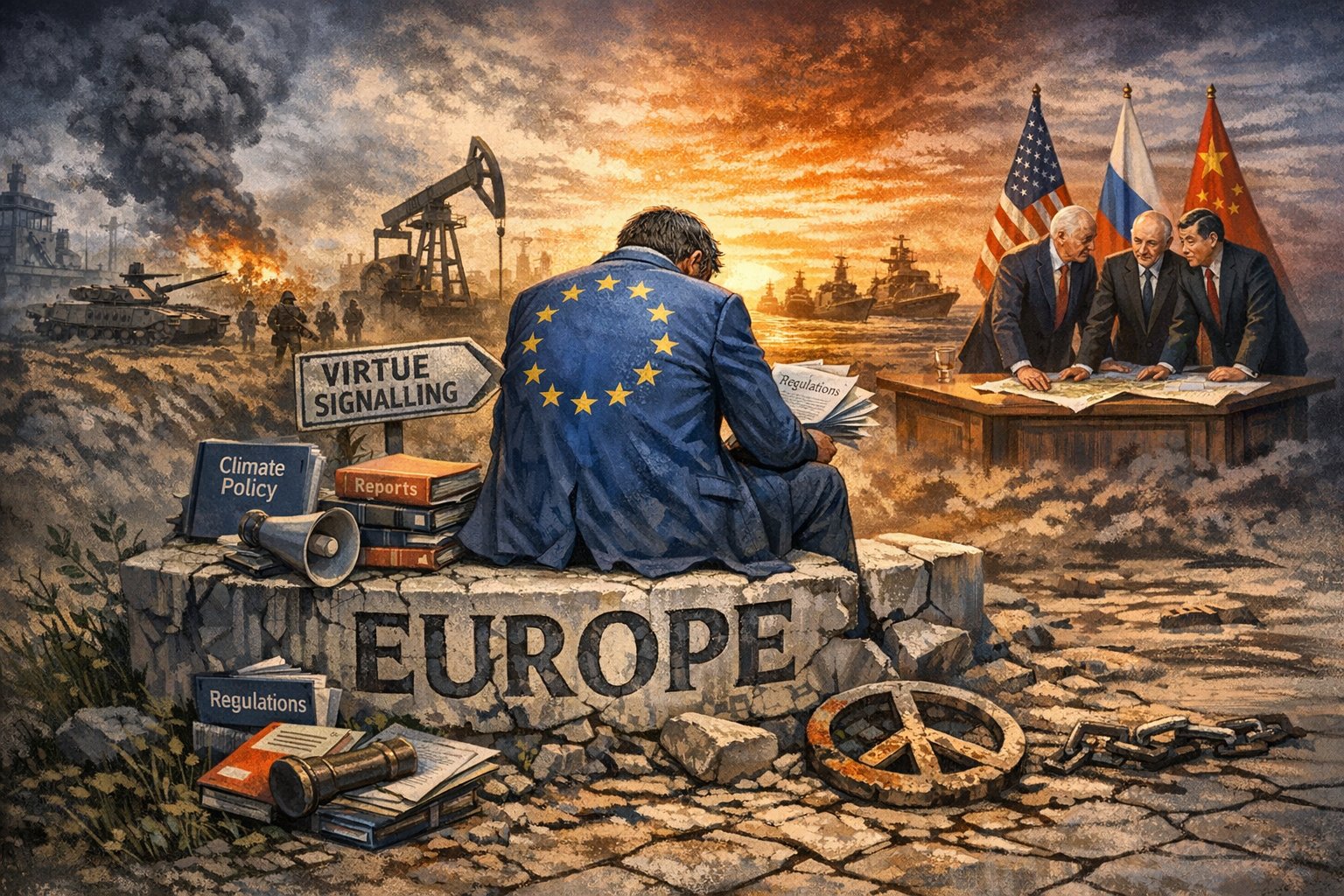
Europe did not wake up one morning to find itself sidelined on the world stage. This was not a sudden betrayal by allies or a conspiracy by rivals. It was the predictable outcome of years spent prioritizing symbolism over strength, process over power, and moral signaling over material capability. While other global actors invested in hard assets — defense, energy security, industrial capacity, strategic autonomy — Europe invested heavily in rhetoric. We built institutions to regulate language faster than we built the ability to deter aggression. We expanded bureaucracies while hollowing out military readiness. We convinced ourselves that being seen as virtuous was a substitute for being taken seriously. It is not. From Moral Authority to Strategic Irrelevance Europe likes to think of itself as a “normative power”: a force that shapes the world through values, diplomacy, and rules rather than coercion. In theory, this is admirable. In practice, it only works when backed by credible force. Instead, Europe allowed virtue signaling to become a governing principle. Policy debates became dominated by optics, identity frameworks, and internal consensus rituals, while uncomfortable questions about security, borders, energy dependence, and military capacity were deferred — or declared impolite. The result is a continent that talks endlessly about responsibility, sustainability, and justice, yet struggles to project influence when it actually matters. When wars break out, Europe reacts. When deals are negotiated, Europe observes. When power is exercised, Europe comments. That is not leadership. Bureaucracy Is Not Power Europe’s institutional instinct is always the same: create a committee, issue a framework, publish a directive. This has produced impressive regulatory machinery — but regulation does not deter missiles, secure shipping lanes, or stop hostile actors from testing red lines. Power respects clarity, capability, and consequences. It does not respect process for its own sake. By confusing administrative sophistication with geopolitical strength, Europe has mistaken complexity for capacity. The world does not. The Cost of “Low-Risk Morality” Virtue signaling is attractive because it feels consequential without being costly. It allows political elites to appear morally engaged while avoiding hard trade-offs. But global politics does not reward intention; it rewards leverage. While Europe debated language and representation, others built facts on the ground. While Europe moralized, others mobilized. While Europe optimized for internal harmony, others optimized for outcomes. Now, when major decisions are made — on war, peace, energy, or security — Europe often finds itself informed rather than consulted. Taking Ourselves Seriously Again If Europe wants to be taken seriously, it must first start acting like it takes itself seriously. That means: Re-centering defense, deterrence, and strategic autonomy. Accepting that security and power are prerequisites for values, not alternatives to them. Streamlining decision-making instead of hiding behind procedural paralysis. Recognizing that credibility abroad begins with coherence at home. This is not a call to abandon values. It is a call to anchor them in reality. Values without power are aspirations. Power without values is dangerous. But values backed by power are influence. The Choice Ahead The world is not becoming softer, slower, or more patient. It is becoming more fragmented, more competitive, and more willing to use force. Europe can either adapt to that reality or continue performing morality for an audience that has already moved on. Wokeness, as governance, has reached its limits. Bureaucracy, as strategy, has failed. Symbolism, as power, has been exposed. If Europe wants a seat at the table again, it must stop confusing virtue with strength — and start rebuilding the things that actually matter. History does not sidestep continents by accident. It sidelines those who choose comfort over consequence.

Europe Has Been Sidelined — And We Did It to Ourselves
1
0Commenti

How did people even survive winters in those old mansions?

So I just read about how Elizabethan mansions dealt with heating and honestly... those people must have been freezing constantly? Like yeah they had massive fireplaces and tapestries on walls for insulation, but come on - those stone buildings with high ceilings and drafty windows? The article mentioned they'd close off entire wings in winter and everyone would basically huddle in a few rooms. Imagine having a 50-room house but only using 3 of them half the year. Makes me appreciate my tiny flat's radiator so much more. Anyone know if there were actually clever heating tricks from back then that we've forgotten about?

1
10Commenti
u/amelied·9mesi fa

Does anyone else feel weirdly nostalgic for office comics?

What happens to workplace humor when we're all scattered across home offices and coworking spaces? I was thinking about this because Dilbert used to be everywhere in offices, right? People would print out strips and stick them on their cubicle walls. My dad had this whole collection. And sure, the creator went off the rails, but that's not really what I'm wondering about... It's more like - that entire genre of humor was built on shared misery. The pointy-haired boss. The endless meetings. The TPS reports. Everyone got the joke because everyone lived it, together, in the same fluorescent-lit building. Now work is so fragmented. Some of us are remote, some hybrid, some still in offices but different kinds of offices. The "corporate culture" we're all supposedly suffering through isn't even the same anymore. My experience of Slack exhaustion is completely different from my friend's experience of back-to-back Zoom calls, which is different from someone else dealing with hot-desking politics. I wonder if we've lost something in that fragmentation - not Dilbert specifically, but that feeling of collective absurdity. Or maybe the humor just lives in different places now? Discord screenshots and Twitter threads instead of comic strips?

1
9Commenti